Frequently-Asked Questions

FAQ for
Basic | Getting Started | Communities | The Cooperative Model | Supporting Us
Suggest a Question

Users | Admins | Networking

Our website uses BuddyBoss with LearnDash for online learning
and full scale social networking features.

About Community Internet

Community Internet is a platform cooperative, a member-owned digital platform for learning, connecting, and organizing around community-owned internet infrastructure. We provide three integrated services: Meetingplace (community networking without ads or tracking), Learningplace (free digital skills and broadband courses), and Marketplace (a member-owned exchange for products and services). We’re a project of the Broadband Institute Foundation, a 501(c)(3) nonprofit based in Michigan.

It means internet infrastructure, the fiber cables, wireless access points, and networking equipment that’s owned and operated by the community it serves, rather than by a corporation. Just like rural electric cooperatives brought power to communities that private utilities wouldn’t serve in the 1930s, community broadband networks bring fast, affordable internet to communities that Big ISPs underserve today. There are over 400 community-owned networks across the U.S. right now.

Three fundamental differences: ownership (you’re a member-owner with a vote, not a product being sold to advertisers), privacy (we never sell data, serve ads, or use algorithms to manipulate your attention), and economics (any surplus revenue stays in the community instead of flowing to shareholders). Our content is Creative Commons licensed, and you can export all your data and leave at any time.

Community Internet was founded by Dr. Ron Suarez through the Broadband Institute, a 501(c)(3) nonprofit. Dr. Suarez is a cognitive neuroscientist turned social impact entrepreneur who founded his first cooperative in 1971, pioneered AI training in the 1980s, and has served Fortune 500 clients including IBM, Harvard, Yale, and Apple. The platform is built to be progressively owned by its members through our Exit to Community model.

Yes — joining is completely free. You can create a member profile, join groups, participate in discussions, and access open courses at no cost. We’re funded through donations, grants, and our cooperative marketplace — not by selling your data or showing you ads.

How to Join & Use the Platform

Visit communityinter.net/register and fill in your details. Once registered, you can set up your member profile, join groups, enroll in courses, and start connecting with other members. The process takes about 5minutes.

As a member you can: join interest-based groups and discussion forums in the Meetingplace, take free courses on digital skills, community broadband, and cooperative governance in the Learningplace, list or browse products and services in the Marketplace, message other members privately, participate in community governance decisions, and build toward cooperative ownership through active participation.

Our Learningplace offers courses on digital skills, community broadband planning, cooperative governance, mesh networking basics, and more. Courses range from beginner-friendly overviews to hands-on technical training. All open courses are free. Visit communityinter.net/open-courses to browse what’s available.

Absolutely. Community Internet is built for everyone — not just technologists. Many of our members are community organizers, educators, seniors learning digital skills, small business owners, and people who simply want an alternative to Big Tech platforms. The courses start from the basics, and the community forums are welcoming to all experience levels.

Go to communityinter.net/groups to see all available groups. Click on any group that interests you and hit “Join Group.” Some groups are public (anyone can join), some are private (you request to join and a group admin approves), and some are hidden (by invitation only). Once you’re in a group, you can participate in discussions, share resources, and collaborate with other members.

Community Broadband & Digital Equity

We provide three things: education (free courses on how community broadband works and how to plan a network), organizing tools (groups, forums, and communication infrastructure to rally your community), and connections (a network of people and organizations already doing this work, from NYC Mesh to rural electric co-ops). We don’t build the network for you — we give your community the knowledge and tools to build and own it yourselves.

In most cases, yes — often significantly. A Harvard Berkman Klein Center study found community networks charged 2.9% to 50% less than private ISPs in comparable markets. In Longmont, Colorado, community-owned gigabit costs $39.95/month. In Ammon, Idaho, the full cost (including infrastructure financing) is around $38–69/month for gigabit — and the community owns the fiber permanently. The average American pays about $78/month and owns nothing.

Digital redlining is when internet service providers systematically underinvest in infrastructure in low-income or minority neighborhoods, resulting in slower speeds, fewer options, and higher prices for those communities. It mirrors the historical practice of redlining in housing. Community-owned networks are one of the most effective solutions because they’re built to serve everyone in the community, not just the most profitable households.

Start here: 1) Take our free community broadband courses on the Learningplace to understand your options (municipal fiber, wireless mesh, cooperative, or open-access models). 2) Join the community broadband groups on our Meetingplace to connect with others who’ve done it. 3) Research your local landscape — what ISPs serve your area, what speeds are available, and whether your state has laws restricting municipal broadband (17 states do). 4) Contact us at communityinter.net/contact — we can help connect you with resources and organizations in your region.

A mesh network is a type of network where devices (called nodes) connect directly to each other and share internet access, rather than all connecting back to a single central point. Think of it like a neighborhood where each house has a small radio that talks to neighboring houses if one house has an internet connection, it can share it across the mesh. NYC Mesh is the most well-known example. Mesh networks are one of the lowest-cost ways to start bringing community-owned connectivity to a neighborhood.

Ownership & Governance

A platform cooperative is a digital platform (website, app, marketplace, or social network) that’s owned and governed by the people who use it — not by venture capitalists or a corporate parent company. In a traditional tech platform, users create the value and investors capture the profit. In a platform cooperative, users create the value and users capture the benefit. Community Internet is a platform cooperative.

Exit to Community is our ownership pathway. Instead of a traditional startup exit (where founders sell to investors or go public), Community Internet is designed to progressively transfer ownership to its members. The pathway is: Join → Learn → Teach → Own. Members who actively participate — taking courses, leading groups, teaching others — earn their way into cooperative ownership with real governance power.

We use consensus-based governance through Loomio, a decision-making platform built for cooperatives. Members can propose, discuss, and vote on decisions that affect the community. Our finances are managed transparently through Open Collective, where anyone can see how money is received and spent.

The internationally recognized cooperative principles are: 1) Voluntary and open membership, 2) Democratic member control (one member, one vote), 3) Member economic participation, 4) Autonomy and independence, 5) Education, training, and information, 6) Cooperation among cooperatives, and 7) Concern for community. These principles, established by the International Cooperative Alliance, guide how Community Internet operates.

Donations & Getting Involved

There are several ways: donate (all donations are tax-deductible through our 501(c)(3) status), partner with us (if you represent an organization), take and share our courses, spread the word on social media, volunteer your skills, or simply join and participate in the community. Every form of engagement helps.

Yes. Community Internet is a project of the Broadband Institute Foundation, a registered 501(c)(3) nonprofit (EIN: 87-4724219). All donations are tax-deductible to the extent allowed by law. You’ll receive a receipt for your records.

Donations fund free digital skills courses, community broadband training programs, solar-powered mini data center infrastructure, and platform development. All of our finances are tracked transparently through Open Collective — you can see exactly where every dollar goes at opencollective.com/broadband-institute.

Yes — we actively seek partnerships with nonprofits, cooperatives, civic tech organizations, educational institutions, and government agencies working on digital equity. Visit communityinter.net/partner or contact us at communityinter.net/contact to start a conversation.

We welcome volunteers with skills in web development, content creation, community organizing, course design, graphic design, video production, and more. Reach out through communityinter.net/contact and tell us what you’d like to contribute.

Suggest a Question

This field is for validation purposes and should be left unchanged.
Your suggestion to add to the FAQ.
Optional to describe an issue
Max. file size: 150 MB.
Optional

FAQ for Users

  • First click on your avatar in the upper right part of the screen to reveal a drop-down menu.
  • Hover down to account to reveal a sub menu where you can select “Notification Settings”
  • See the next screenshot for the period of settings.

As things occur inside a group, the additions or changes are posted to the activity feed. Click to see the Activity Feed for the Planning Broadband Ecosystems Group.

Each course may contain multiple lessons, and each course may belong to a Social Group. Belonging to a social group, enables you to interact with others, including posting to a Discussion Forum.

YouTube player
This video explains how the messaging works, plus some additional features for administrators.
YouTube player
The privacy settings are public, private, or hidden.
YouTube player

FAQ for Admins

If you are an administrator, go here for help.

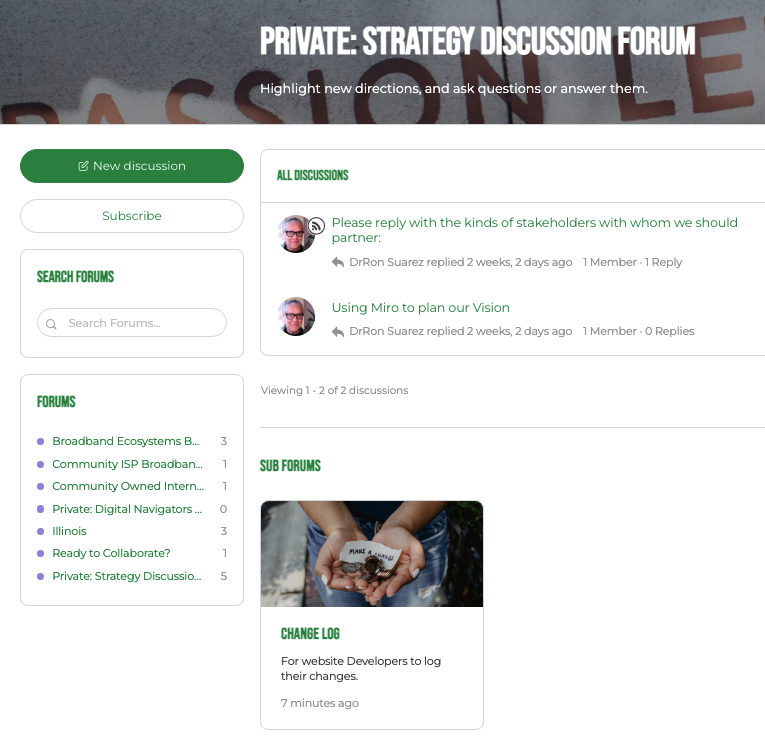
The screenshot below shows that “Strategy Discussion” is a private forum, and it has a sub forum called “change log.”
YouTube player

FAQ for Networking

Althea
A peer-to-peer routing and machine billing protocol
Althea L1
A micropayment-specialized blockchain network
Whitepaper v2.0 Apr 2024 (Download)
Justin Kilpatrick, Jehan Tremback, Deborah Simpier, Christian Borst
{justin, jehan, deborah, christian}@althea.net

Abstract
In the seven years since the original Althea whitepaper was published, the Althea networking
and billing protocol has been developed and iterated, and it is now used to provide commercial
home internet around the world. This updated paper seeks to place the present state of the
Althea network protocol in context with new developments. Specifically, Althea L1 as a
blockchain platform specifically tuned, but not exclusively for, micropayments generated by
routers running the Althea networking and billing protocol.

The Babel routing protocol, more commonly known as B.A.T.M.A.N. (Better Approach To Mobile Adhoc Networking), is a routing protocol for multi-hop mobile ad hoc networks which are often utilized in mesh networks. Rather than using a traditional routing table of fixed routes, the B.A.T.M.A.N. protocol continuously determines the best way to forward data packets to their destination based on a decentralized link-quality algorithm. This method allows each node in the network to independently find the most efficient route by analyzing the data traffic it observes.

Each node maintains information on the best next hop towards every other node, rather than trying to determine the full route. Through the exchange of information contained in OGM (Originator Message) packets that every node broadcasts, nodes monitor the quality of links and decide on the most reliable next hops based on the data they receive. The B.A.T.M.A.N. protocol is particularly effective in dynamic environments where network topology frequently changes, making it suitable for mobile devices and disaster recovery communications.

YouTube player
History Of Networking – Juliusz Chroboczek – Babel Routing Protocol

The Border Gateway Protocol (BGP) is a protocol used to manage how packets are routed across the internet through the exchange of routing and reachability information among edge routers. BGP is classified as a path vector protocol, which is a type of distance vector routing protocol. It enables the internet to function by making routing decisions that route data and information efficiently from one part of the internet to another.

Here’s a breakdown of how BGP, specifically as a path vector protocol, operates:

  1. Path Vector Mechanics: Unlike traditional distance vector protocols that only send information about distance metrics or hop counts to neighboring nodes, BGP conveys full paths (lists of ASes or Autonomous Systems that the routing information has passed through). This method helps in avoiding routing loops and makes routing decisions more robust and reliable.
  2. Routing Information Exchange: BGP routers (or speakers) establish a TCP connection with each other for a reliable exchange of routing information. Once the connection is established, BGP speakers exchange full routing tables initially and thereafter only exchange incremental updates.
  3. Decision Process: BGP uses several attributes, including AS path, origin, next hop, and others, to make sophisticated routing decisions. The protocol uses its Path Attributes to decide the most favorable route to a network that offers the best path according to its policies.
  4. Policies and Customization: BGP is highly customizable, allowing network administrators to influence the route selection process based on policies. These policies can be based on path attributes like the length of the AS path, policy rules, or traffic agreements.
  5. Scalability and Performance: Given its crucial role in the functioning of the internet, BGP is designed to be extremely scalable and can handle thousands of routes. The ability to filter and manipulate routes according to administrative policies allows it to effectively manage the complex and diverse routing needs of the global internet.

BGP’s design as a path vector protocol is essential in maintaining a stable, scalable, and efficient routing framework for the internet, facilitating data transfer across different networks and ISPs efficiently and reliably.

YouTube player
What is BGP (Border Gateway Protocol)? An Introduction