Open Social Graph


this is a work in progress
Social Graph: Open Connectivity & Ambient Access Infrastructure Network
Overview
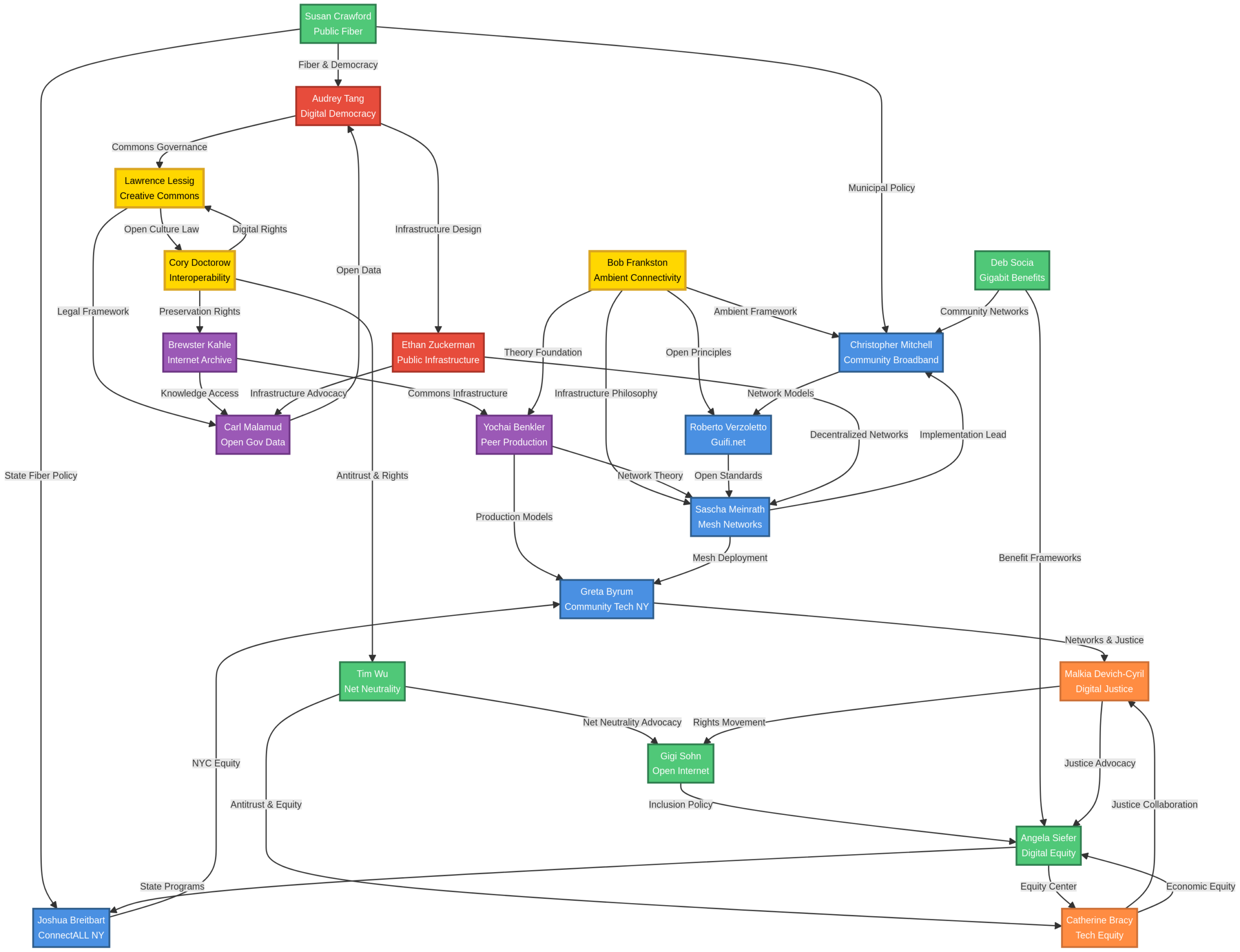
This social graph visualizes the collaborative network among the Top 20 Proponents of Open Connectivity & Ambient Access Infrastructure as identified in the Medium article by DrRon Suarez. The graph maps strategic relationships, knowledge exchanges, and collaboration opportunities that can advance the movement toward universal ambient connectivity.
Graph Structure
Node Categories
The network is organized into five thematic clusters, each represented by distinct colors:
1. Infrastructure & Technical Implementation (Blue)
These actors focus on building and deploying physical and logical network infrastructure:
- Christopher Mitchell – Community Broadband expert at ILSR
- Sascha Meinrath – Mesh network pioneer (Commotion Wireless)
- Roberto Verzoletto – Guifi.net leader (world’s largest community network)
- Greta Byrum – Community Tech NY co-founder
- Joshua Breitbart – ConnectALL NY state broadband leader
2. Policy & Advocacy (Green)
These proponents shape regulatory frameworks and public policy:
- Tim Wu – Net Neutrality originator
- Susan Crawford – Public fiber and open access policy advocate
- Gigi Sohn – Open internet policy expert at Benton Institute
- Angela Siefer – Digital equity movement leader at NDIA
- Deb Socia – Gigabit community benefits strategist
3. Digital Rights & Legal Framework (Orange)
These advocates establish legal foundations for digital freedom:
- Cory Doctorow – Adversarial interoperability and digital rights champion
- Lawrence Lessig – Creative Commons founder
- Malkia Devich-Cyril – Digital rights and racial justice advocate
- Catherine Bracy – Tech equity and housing justice leader
4. Knowledge Commons & Open Access (Purple)
These leaders democratize access to information and knowledge:
- Brewster Kahle – Internet Archive founder
- Carl Malamud – Open government data advocate
- Yochai Benkler – Commons-based peer production theorist
5. Digital Democracy & Public Infrastructure (Red)
These innovators reimagine governance and public digital systems:
- Audrey Tang – Taiwan’s Digital Minister, radical transparency pioneer
- Ethan Zuckerman – Digital public infrastructure advocate
Hub Nodes (Gold)
Three individuals serve as critical connectors across multiple domains:
- Bob Frankston – Coined “Ambient Connectivity,” provides theoretical foundation
- Cory Doctorow – Bridges digital rights, technical implementation, and advocacy
- Lawrence Lessig – Connects legal frameworks to cultural and technical commons
Edge Relationships: Collaboration Pathways
Theory to Practice
These edges translate conceptual frameworks into actionable implementations:
- Bob Frankston → Christopher Mitchell: Ambient connectivity framework guides community broadband
- Bob Frankston → Sascha Meinrath: Infrastructure philosophy shapes mesh networks
- Yochai Benkler → Sascha Meinrath: Commons theory informs network design
- Yochai Benkler → Greta Byrum: Peer production models enable community ownership
Policy Development
These relationships advance regulatory and legislative agendas:
- Tim Wu → Gigi Sohn: Net neutrality advocacy coordination
- Susan Crawford → Christopher Mitchell: Municipal broadband policy development
- Susan Crawford → Joshua Breitbart: State-level fiber infrastructure policy
- Gigi Sohn → Angela Siefer: Digital inclusion policy integration
- Deb Socia → Angela Siefer: Community benefit frameworks for equity
Legal & Rights Framework
These connections establish legal protections for open connectivity:
- Lawrence Lessig → Cory Doctorow: Open culture law and interoperability rights
- Lawrence Lessig → Carl Malamud: Legal frameworks for open access
- Cory Doctorow → Tim Wu: Antitrust enforcement and digital rights
- Malkia Devich-Cyril → Angela Siefer: Equity and justice advocacy alignment
- Catherine Bracy → Malkia Devich-Cyril: Tech justice collaboration
Knowledge Sharing
These edges facilitate information exchange and collective learning:
- Brewster Kahle → Carl Malamud: Universal knowledge access strategies
- Carl Malamud → Audrey Tang: Open government data practices
- Brewster Kahle → Yochai Benkler: Digital commons infrastructure
Implementation & Deployment
These relationships drive real-world network construction:
- Sascha Meinrath → Greta Byrum: Mesh network deployment expertise
- Christopher Mitchell → Roberto Verzoletto: Community network model exchange
- Joshua Breitbart → Greta Byrum: NYC broadband equity coordination
- Roberto Verzoletto → Sascha Meinrath: Open network standards development
Digital Democracy
These connections advance participatory governance models:
- Audrey Tang → Ethan Zuckerman: Digital public infrastructure design
- Ethan Zuckerman → Sascha Meinrath: Decentralized network governance
- Audrey Tang → Lawrence Lessig: Digital commons governance frameworks
Cross-Domain Collaboration
These edges bridge different areas of expertise:
- Cory Doctorow → Brewster Kahle: Digital preservation rights
- Susan Crawford → Audrey Tang: Public fiber meets digital democracy
- Tim Wu → Catherine Bracy: Tech antitrust and equity intersection
- Angela Siefer → Joshua Breitbart: State digital equity program coordination
- Deb Socia → Christopher Mitchell: Gigabit community network benefits
Advocacy & Movement Building
These relationships strengthen collective action:
- Malkia Devich-Cyril → Gigi Sohn: Digital rights movement coordination
- Catherine Bracy → Angela Siefer: Economic and digital equity alignment
- Ethan Zuckerman → Carl Malamud: Public infrastructure advocacy
- Greta Byrum → Malkia Devich-Cyril: Community networks and justice integration
Strategic Collaboration Opportunities
1. Infrastructure Development Coalition
Members: Bob Frankston, Christopher Mitchell, Sascha Meinrath, Roberto Verzoletto, Greta Byrum, Joshua Breitbart
Objective: Deploy community-owned, open-access networks using ambient connectivity principles
Key Activities:
- Share technical standards and deployment methodologies
- Coordinate funding strategies for community networks
- Develop replicable models for municipal and community broadband
- Create open-source tools and documentation
2. Policy & Regulatory Reform Alliance
Members: Tim Wu, Susan Crawford, Gigi Sohn, Angela Siefer, Deb Socia
Objective: Advance legislation and regulations supporting open connectivity and digital equity
Key Activities:
- Coordinate advocacy campaigns for net neutrality and open access
- Develop model legislation for municipal broadband
- Create policy frameworks linking infrastructure to equity outcomes
- Engage in regulatory proceedings at FCC and state levels
3. Digital Rights & Justice Network
Members: Cory Doctorow, Lawrence Lessig, Malkia Devich-Cyril, Catherine Bracy
Objective: Establish legal and social frameworks protecting digital rights and promoting equity
Key Activities:
- Litigate for interoperability rights and against monopolistic practices
- Advocate for tech industry accountability and worker protections
- Center racial and economic justice in digital policy
- Develop legal tools for community network protection
4. Knowledge Commons Consortium
Members: Brewster Kahle, Carl Malamud, Yochai Benkler
Objective: Ensure universal access to knowledge and government information
Key Activities:
- Archive and preserve digital public resources
- Advocate for open access to publicly funded research and data
- Develop theoretical frameworks for commons-based production
- Create tools for knowledge sharing and preservation
5. Digital Democracy Lab
Members: Audrey Tang, Ethan Zuckerman
Objective: Design and implement participatory digital governance systems
Key Activities:
- Pilot radical transparency and civic participation platforms
- Develop decentralized social media and communication tools
- Create models for digital public infrastructure
- Share best practices for digital democracy implementation
Integration with Community Support Infrastructure
The provided No Shit Support logos represent the critical community support layer that enables these collaborations to succeed. This infrastructure connects to the network through:
Technical Support Pathways
- Greta Byrum (Community Tech NY): Direct community technical assistance
- Sascha Meinrath: Mesh network deployment support
- Roberto Verzoletto: Guifi.net community support model
Equity & Access Support
- Angela Siefer: Digital inclusion support services
- Malkia Devich-Cyril: Community organizing and advocacy support
- Catherine Bracy: Economic equity and housing support integration
Key Figures
Cory Doctorow
As depicted in the provided image, Cory Doctorow serves as a pivotal bridge between technical implementation, legal frameworks, and advocacy movements. His work on adversarial interoperability provides the legal foundation for open connectivity efforts.
Reference Model: Economic & Workforce Development
The provided social graph example (Mamdani development network) demonstrates how organizational relationships can be mapped across economic development, workforce development, and policy domains. This model informs the structure of the ambient connectivity network, showing how:
- Sectoral partnerships (similar to infrastructure coalitions) enable coordinated action
- Policy research (similar to knowledge commons) informs strategic decisions
- Leadership connections (similar to hub nodes) facilitate cross-domain collaboration
- Skills training and placement (similar to community support) ensure equitable access
Activation Strategies
Phase 1: Foundation Building (Months 1-6)
- Convene hub nodes (Frankston, Doctorow, Lessig) to establish shared vision
- Map existing collaborations and identify gaps
- Develop shared resources (policy templates, technical standards, legal frameworks)
- Create communication infrastructure for ongoing coordination
Phase 2: Coalition Formation (Months 7-12)
- Launch five strategic coalitions as defined above
- Coordinate advocacy campaigns across policy and rights domains
- Pilot community network deployments using shared models
- Establish knowledge sharing platforms and regular convenings
Phase 3: Movement Scaling (Year 2+)
- Replicate successful models across new communities
- Advance legislative victories at local, state, and federal levels
- Expand digital rights protections through litigation and regulation
- Build sustainable funding mechanisms for community networks
- Center equity and justice in all deployment and policy decisions
Metrics for Success
Network Growth
- Number of community-owned networks deployed
- Population served by open-access infrastructure
- Geographic coverage of ambient connectivity
Policy Impact
- Legislation passed supporting municipal broadband
- Regulatory decisions protecting net neutrality and open access
- Legal precedents established for interoperability rights
Equity Outcomes
- Reduction in digital divide metrics
- Diversity of network ownership and governance
- Integration of justice frameworks in deployment decisions
Knowledge Sharing
- Open resources created and shared
- Cross-pollination between coalitions
- Replication of successful models
Conclusion
This social graph reveals a robust ecosystem of expertise, advocacy, and implementation capacity. By activating the relationships mapped here, the ambient connectivity movement can accelerate the transition from proprietary, extractive telecommunications models to open, community-owned, equitable infrastructure that serves as a true public good—as essential and accessible as sidewalks, as Bob Frankston envisions.
The integration of technical innovation (mesh networks, community broadband), policy reform (net neutrality, municipal fiber), legal frameworks (interoperability rights, creative commons), knowledge commons (open access, peer production), and digital democracy (participatory governance, public infrastructure) creates a comprehensive strategy for achieving universal ambient connectivity.
Graph Created: December 2025
Source Article: Top 20 Proponents of Open Connectivity & Ambient Access Infrastructure by DrRon Suarez
Visualization: Mermaid network diagram with color-coded thematic clusters and labeled relationship edges
Key Features
Network Structure: The graph includes all 20 individuals from the Medium article as nodes, organized into five color-coded clusters:
- Blue: Infrastructure & Technical Implementation (Mitchell, Meinrath, Verzoletto, Byrum, Breitbart)
- Green: Policy & Advocacy (Wu, Crawford, Sohn, Siefer, Socia)
- Orange: Digital Rights & Legal Framework (Doctorow, Lessig, Devich-Cyril, Bracy)
- Purple: Knowledge Commons & Open Access (Kahle, Malamud, Benkler)
- Red: Digital Democracy & Public Infrastructure (Tang, Zuckerman)
- Gold: Hub Nodes (Frankston, Doctorow, Lessig)
Labeled Edges: 46 relationships showing specific transactions including:
- Theory-to-practice knowledge flows
- Policy development collaborations
- Legal framework coordination
- Implementation partnerships
- Cross-domain bridges
- Movement building alliances
Hub Connectors: Bob Frankston (ambient connectivity theory), Cory Doctorow (digital rights), and Lawrence Lessig (legal frameworks) serve as critical bridges across multiple domains.



Responses