
Internet as a Public Amenity: How Ann Arbor Could Bundle Broadband Into Publicly Owned Housing

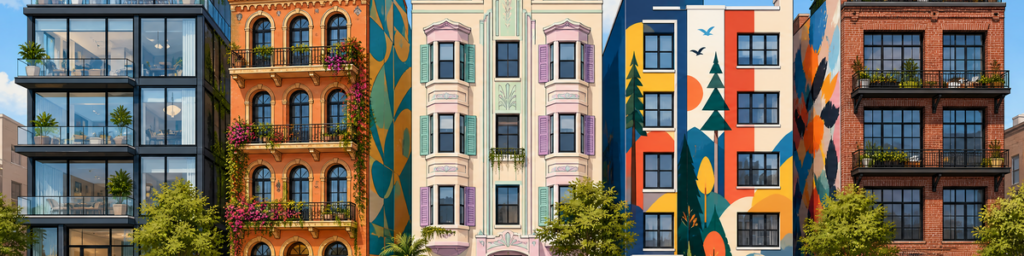
The buildings shown in the featured image do not make much sense right next to each other, but picture one of them replacing the 20 story buildings that have been going up in Ann Arbor. Leave a comment for the style you like best.
We already expect public housing to come with water at the tap and heat in the winter. In 2026, high-speed Internet belongs on that same list — and Ann Arbor already owns the infrastructure to deliver it.
- The problem with the ISP-by-the-door model
- Ann Arbor already owns the hard part: the backbone
- We’ve already proven the savings — right here in Ann Arbor
- How it would work
- Why this fits Ann Arbor’s moment
- References & sources
We already expect public housing to come with water at the tap, heat in the winter, and a light in the hallway. In 2026, high-speed Internet belongs on that same list. It is how people apply for jobs, see a doctor, do their homework, and stay connected to family. Yet in most publicly supported housing, residents are left to negotiate individually with Comcast, Verizon, or AT&T — paying retail prices, one apartment at a time, for a service the building could simply provide.
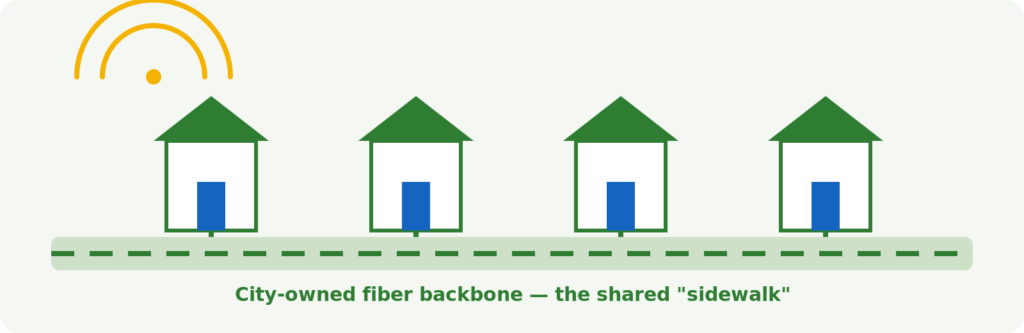
There is a better model, and Ann Arbor is unusually well positioned to build it. The city can treat Internet the way it treats a sidewalk: shared infrastructure, owned by the community, that connects everyone who lives there.
1. The problem with the ISP-by-the-door model
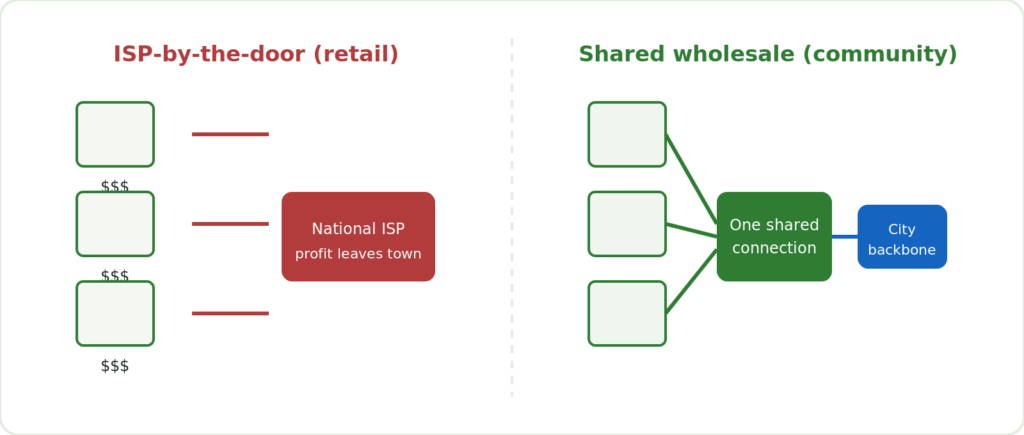
When each household signs its own contract with a national ISP, three things happen at once:

THE CORE ISSUE
Publicly owned and affordable housing is supposed to lower the cost of living. Bundling Internet as an amenity does precisely that — while ISPs’ per-door pricing quietly works against it. Neighbors collaborating is like a pod of dolphins defeating a shark.
2. Ann Arbor already owns the hard part: the backbone
Most communities that want municipal broadband have to start by burying fiber, which is slow and expensive. Ann Arbor doesn’t. The city already owns more than 44 miles of backbone fiber-optic cable inside city limits, with additional route planned toward Ypsilanti.[1] That network is built in resilient multi-ring configurations for failover and redundancy, and the city makes dark fiber available to public and commercial organizations through a Fiber and Conduit Use Agreement.[1] The city’s institutional network initiative (A2-INET) is designed to carry gigabit-plus connectivity to sites across town.[2]
WHY IT MATTERS
The expensive spine already exists and is publicly owned. Connecting a housing development to it is a “last-mile” problem — running fiber from a nearby city route into the building and lighting up the units — not a “build a network from scratch” problem. That changes the economics entirely.

Join a Town Hall to discuss these issues or use our tools to organize one in your town with your issues
3. We’ve already proven the savings — right here in Ann Arbor
This isn’t theoretical. Through the Broadband Institute Foundation (dba CommunityInternet), working with our partners at 123Net, we delivered free Internet service to 50 affordable housing units at the Veridian at County Farm “net zero” development in Ann Arbor. Combined electricity and Internet savings for participating households come to an estimated $3,600 per year.[3]
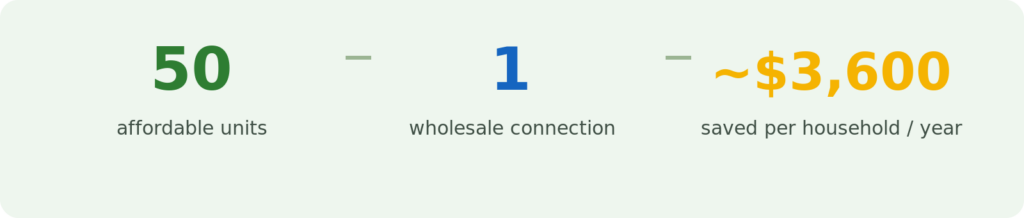
The mechanism is simple and repeatable. Instead of 50 households buying 50 retail plans, the community buys one wholesale connection and shares it across the building — in Veridian’s case, funded through homeowners-association fees.[3] Wholesale pricing is a fraction of retail, so residents get reliable, high-speed connectivity and keep more money in their pockets for the essentials that actually need it.
Now imagine applying that same wholesale, bulk-purchase model to publicly owned housing, but connecting it to the city’s own fiber backbone rather than a third party’s network. The savings compound, and the value stays local.
4. How it would work
A publicly owned housing “Internet as amenity” program in Ann Arbor could follow a straightforward path:
- Tap the backbone. Execute a Fiber and Conduit Use Agreement to connect the development to the nearest city fiber route — using infrastructure the public already owns.[1]
- Buy connectivity wholesale. Purchase a single high-capacity connection for the building and distribute it to every unit, the way Veridian did, instead of dozens of separate retail accounts.[3]
- Build the amenity in. Fold basic high-speed service into the rent or operating budget as a standard amenity — like heat or water — so no resident has to opt in, qualify, or fall behind on a separate bill.
- Train and hire locally. Bring residents into managing and maintaining the network. This keeps operating dollars in the community and builds real digital-literacy and technical skills.[3]
- Reinvest the savings. Because the network is community-owned, any surplus goes back into upgrades, coverage, and digital-equity programs rather than out to distant shareholders.

5. Why this fits Ann Arbor’s moment
Ann Arbor is already debating what it means to own its own essential infrastructure — most visibly through the push for public power and a Sustainable Energy Utility.[4] Community-owned Internet is the natural companion to community-owned energy. Both rest on the same principle: the essentials of modern life shouldn’t be extraction points for out-of-state monopolies; they should be commons that lower costs and strengthen the community that maintains them.
Bundling Internet into publicly owned housing is one of the highest-leverage, lowest-risk ways to act on that principle. The backbone is built. The wholesale model is proven a few miles away at Veridian. The savings — roughly $3,600 a year per household in that project — are real and measurable. What’s missing is the decision to treat connectivity as public infrastructure rather than a private add-on.
THE VISION
We envision a future where the Internet is a public commons — connecting neighbors the way the sidewalk already does. In Ann Arbor, that future is closer than most people realize. It’s mostly a matter of plugging our housing into the network we already own.
References & sources
- City of Ann Arbor, “A2 Community Dark Fiber Access and Availability” — 44+ miles of city backbone fiber, multi-ring resiliency, dark fiber available via Fiber and Conduit Use Agreement. a2gov.org ↩
- City of Ann Arbor institutional network (A2-INET) — city-owned fiber providing gigabit+ connectivity and backhaul to sites across the city (city IT / fiber engineering solicitation). mitn.info ↩
- DrRon Suarez / Broadband Institute Foundation (dba CommunityInternet), “Affordable, Community-Owned Internet & Electricity Eco-solutions,” Nov. 19, 2025 — free Internet to 50 units at Veridian at County Farm with 123Net; ~$3,600/yr combined electricity + Internet savings; wholesale pricing via bulk purchase funded through HOA fees. communityinter.net ↩
- Edith Pendell, “Ann Arbor mayoral candidates debate housing and energy at forum,” Michigan Public, June 25, 2026 — context on Ann Arbor’s public-power / Sustainable Energy Utility debate. michiganpublic.org ↩
About: The Broadband Institute Foundation (BIF), dba CommunityInternet, helps communities build and manage their own broadband networks — keeping costs low and reinvesting benefits locally. If you work in local government, affordable housing, a library, or a school, or you just care
about closing the digital divide, we’d love to hear from you: social@communityinter.net · 326.266.6667 (DAO-COM-MONS).
Join a Town Hall to discuss these issues or use our tools to organize one in your town with your issues


Responses