
CommunityInter.net is a Platform Cooperative with Responsible AI


Don’t be “Twiddled” by AI
Some companies use AI to “Twiddle” users.
They search the web for information to extract wealth from your pocket.
Hospitals have used AI to search a job applicants’ credit history.
The more debt the smaller the salary offered.
Twiddling represents the big cognitive hazard from enshittification during the AI bubble: the parts of your UI that matter most to you are the parts that you use as vital cognitive prostheses. A product team whose KPI is “get users to tap on an AI button” is going to use the fine-grained data they have on your technological activities to preferentially target these UI elements that you rely on with AI boobytraps. You are too happy, so they are leaving money on the table, and they’re coming for it.
Cory Doctorow, 2025
We are Restoring the Internet as a Public Commons

One community at a time: While we support digital navigators, who assist people to connect to the dominant system (incumbent ISPs), our ultimate goal is to work with community stakeholders to build and own their Internet infrastructures in an emergent system.
The world changes as pioneers of an emergent system, find each other and work together. That is the goal of our community.
Berkana Two Loops Model of System Change

Give people fish?
Teach people to fish?
Change the fishing industry?
Addressing the digital divide is a complex problem that requires fundamental systemic change to produce a sustainable outcome. The dominant system (the incumbent ISP’s) created the digital divide, e.g. digital redlining. Various government projects and certain nonprofits have been acting as stabilizers to address inequities with efforts, such as subsidies like the Affordable Connectivity Program (ACP). “Hospice Work” for the declining system would include things like digital navigator programs, that assist, underserved populations with help to apply for ACP. This website is part of the effort to recruit pioneers that we assist in connecting and building networks, from interpersonal connections to physical Internet infrastructure networks that are owned by the local community. It is thus our goal to form communities of practice that nourish each other and help the new emergent system to grow in influence.

A Bit of Internet History

Before the privatization of the Internet during the 1990s, as discussed by Ben Tarnoff, there was NSFnet, which existed as a Public Commons. The following quote is by David Bollier (link to his membership on this site). He is the author of The Wealth of the Commons, a World Beyond Market & State.
The end-to-end principles of the Internet and its shared protocols constitute a vital infrastructure for creating countless online commons. This lecture gives a brief overview of this history, with readings by Lawrence Lessig, Richard Stallman, Eben Moglen, David Bollier, Elinor Ostrom and Charlotte Hess.
Listen to this podcast by David Bollier
What is a Platform Cooperative?
Do you have 90 seconds to watch?

How about 13 minutes for this video?
Community-Owned AI: The Next Layer of the Commons
At the top of this page we warned about being “Twiddled” by AI. The answer is not to avoid artificial intelligence. It is to own it. Just as we help communities build and own their Internet infrastructure, we are now supporting local artificial intelligence that is owned by the community where it is located. When the people who use an AI system also own and govern it, that AI functions as a cooperative.
What community-owned AI looks like
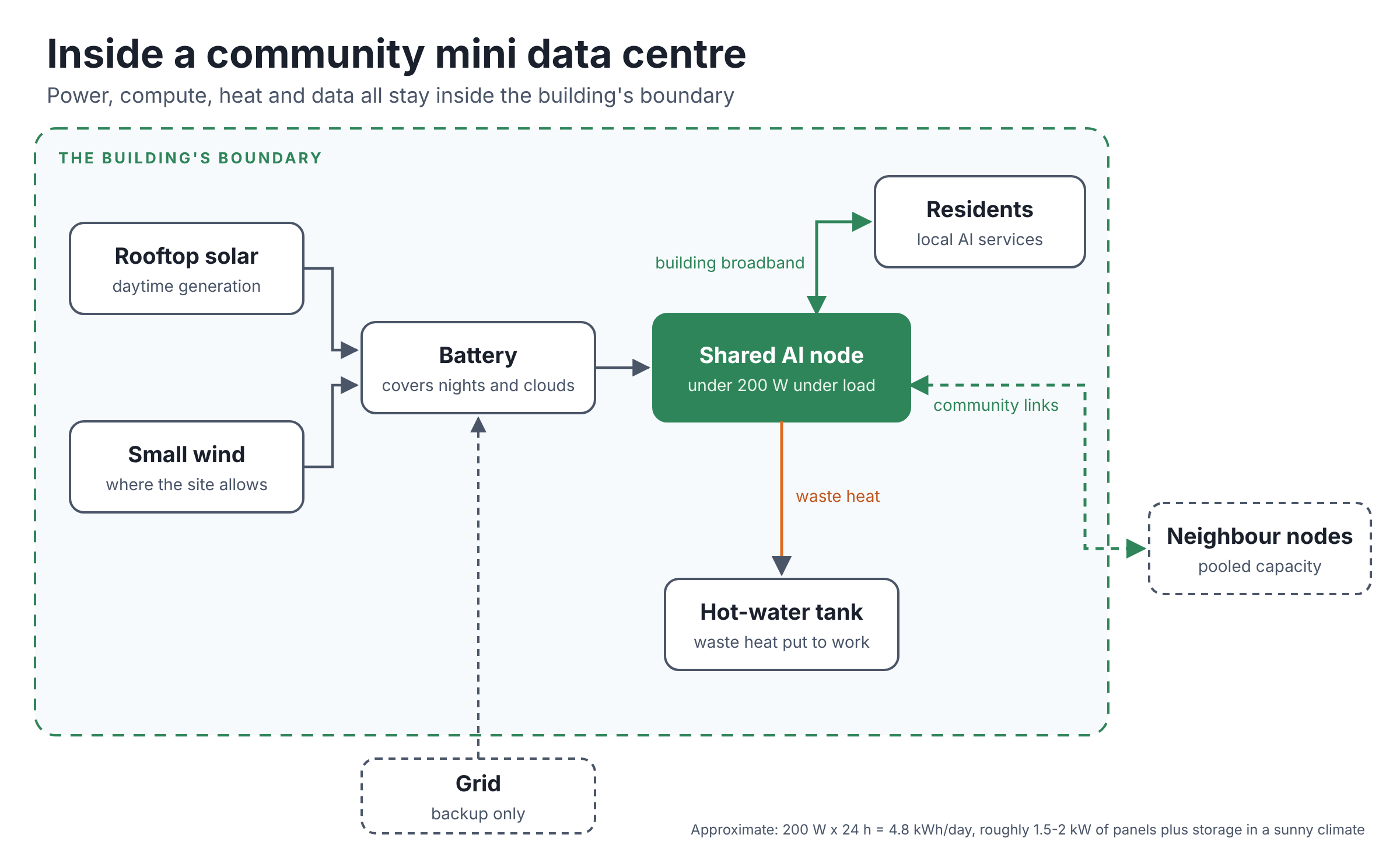
- A shared AI appliance in the building, not a distant data center. Today’s desktop-class AI systems draw under 200 watts and fit in a utility room, yet run capable open models for a whole building or block.
- Carried by the network the community already owns. The same building-owned broadband we pioneered at the 200-unit Veridian at County Farm in Ann Arbor can deliver local AI services to every unit.
- Powered by sun and wind where possible. Rooftop solar, small wind and battery storage can carry a load that size, and the server’s waste heat can help warm the building’s water.
- Data stays home. Questions, records and locally tuned models stay inside the community’s boundary, under rules the members set. As our partners at podCOIN AI put it, “the boundary is the product.”
How it works as a cooperative
Community-owned AI follows the same seven cooperative principles that guide co-ops around the world:
- Voluntary and open membership. Residents, tenants, local businesses and community organizations can join.
- Democratic member control. One member, one vote on how the AI is used, what data it may touch, and which models it runs.
- Member economic participation. Members share the costs and the savings, and any surplus funds the next community node instead of distant shareholders.
- Autonomy and independence. No lock-in to a Big Tech cloud: open models the community can inspect, change or replace.
- Education, training and information. Our communities of practice and digital navigators help members use, understand and steward the system.
- Cooperation among cooperatives. Local nodes link into a community mesh and share capacity with neighboring buildings and co-ops.
- Concern for community. Services are chosen by and for the community, such as tutoring, translation, help with public benefits and searching local knowledge.
Mutual aid, not extraction
Members contribute time, skills and spare computing capacity, and earn the same in return: an hour given for an hour earned. That is the opposite of Twiddling. Instead of AI that searches for ways to extract wealth from your pocket, community-owned AI keeps value, knowledge and control circulating where people live.
Join the pioneers
In the language of the Two Loops model, community-owned AI is part of the emergent system. If you live in a multi-unit building, run a co-op, library or community organization, or simply want AI that answers to you, join our community of practice and help us build the next layer of the commons, one community at a time.

Responses